


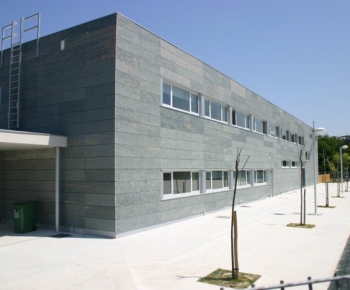

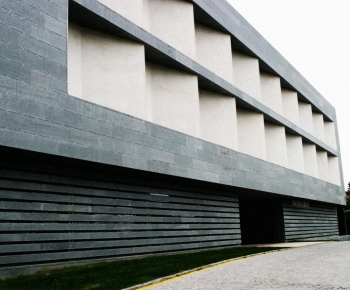



Ventilated facades
A ventilated facade improves a building’s thermal insulation by allowing for the installation of continuous insulation layers between the external load-bearing wall structure and the facade’s exterior cladding. A ventilated facade is a multi-layered system that ensures long-term performance; when properly installed, it enhances the building’s safety and extends its service life.
The cladding of the ventilated facade protects the load-bearing structure, thermal insulation, and support base from weather conditions; it is impact-resistant and rainproof. The insulation provides maximum thermal retention for the interior components, preventing heat loss in the winter.
In summer, a large amount of heat acting on the cladding is dissipated through the airflow in the ventilated space. In this way, a comfortable indoor environment is achieved.

1 – Cladding
- It provides protection against environmental factors such as temperature fluctuations, rain, wind, etc., and defines the building’s appearance.
- It must maintain its shape, layout, and characteristics over time.
- Movements of the cladding due to temperature and humidity changes must not affect the supporting element.
2 – Anchoring
- Anchors the cladding to the building, transmitting the loads it generates (from its own weight, wind pressure, and other sources). It must allow for perfect stabilization of the cladding
3 – Air gap
Rear ventilation of the membrane allows for:
- The drainage of water resulting from rainfall that may eventually seep in.
- The removal of moisture that is transmitted from the interior to the exterior through transpiration.
4 – Insulation
- It acts as a continuous envelope around the entire building, preventing thermal bridges.
- It must allow the masonry to breathe, prevent condensation, and provide thermal and acoustic protection for the building.
- Only materials that can be exposed to the elements without compromising dimensional stability and insulation capacity should be used.
5 – Interior Masonry
- Supports the insulation and contributes to sufficient thermal efficiency
The outer walls of the bearings and the insulation always remain dry and thus fully maintain their function. Any rainwater that may have seeped through open joints will be quickly dried by the air circulation in the ventilation space.
The reduced resistance to water vapor transmission in the layers that make up the envelope allows moisture to be eliminated through the ventilated space. This feature prevents water condensation inside the enclosure and prevents the growth of mold.
The ventilated cavity creates a “chimney effect” caused by the heating of the outer surface, which produces a difference in density between the air layer in the cavity and the ambient air, resulting in upward movement. During the summer, much of the radiant heat is reflected outward due to the aforementioned chimney effect, while in the colder months the wall of the cavity acts as an internal heat accumulator. These solutions also ensure greater sound insulation and the elimination of thermal bridges, reducing noise pollution by 10% to 20%. Correcting thermal bridges results in energy savings, reducing energy consumption by 25 to 40% for heating and cooling.


Reviews
There are no reviews yet.