Description

Our resilient railway components can be grouped into three categories based on their application on railway tracks.

a) UNDER-BALLAST MATS (UBM Under-Ballast Mats and SBM – Sub-Ballast Mats) are used in the ballast bed of the track and come in two variants depending on their purpose:

  • As primary insulation against vibration
  • As a stress reducer in the ballast box of thetrack

b) TRACK SLAB MATS (STM Slab Track Mats) are used on tracks without a ballast box, and are installed underneath and/or on the sides of the slab on which the track is laid

c) LOWER SUPPORTS FOR SLEEPERS (UTP Under Sleeper Pads) must be connected to all sleepers to ensure the sleeper connection to the This precaution increases </ i>the performance of the track system, reducing compaction stresses and thereby increasing the service life of the components. It must be incorporated into the base of the rails during their installation process </

c) LOWER SUPPORTS FOR CROSSBEAMS (UTP Under Sleeper Pads) must be connected to all sleepers to ensure the sleeper connection to This precaution increases </ i>the performance of the rail system, reducing compaction stresses, thereby increasing the service life of the components. It must be incorporated into the base of the rails during the prefabrication process

Materials and Their Properties

Our systems are made from recycled rubber from used truck tires combined with polyurethane elastomer. The entire process of collection, shredding, and production is thoroughly controlled. The use of recycled material results in energy savings and prevents pollution. For every square meter of anti-vibration mat, two medium-sized tires are recycled.

The most relevant technical characteristics of the resilient elements, which are most important for their function, are:

  • Effective vibration isolation – maximum reduction of impact and vibration levels in the structure and of noise
  • Extended service life – maintaining the characteristics mentioned above over the long term under actual operating conditions, with minimal deviation from the parameters obtained in laboratory fatigue tests under extreme operating conditions

The above requirements are the most important parameters for achieving a high-quality resilient track mat and can be determined during its operation (vibration isolation, service life, material characteristics according to specific operating conditions). In the case of vibration isolation, these are:

  • Static and dynamic vertical stiffness, static and dynamic vertical modulus of elasticity
  • Static horizontal stiffness and horizontal modulus of compression
    The above requirements are the most important parameters for achieving a high-quality resilient track mat and can be determined based on its intended function (vibration isolation, service life, material characteristics according to specific conditions of use). In the case of vibration isolation, these are:

    • Static and dynamic vertical stiffness, static and dynamic vertical stiffness modulus
    • Static horizontal stiffness and static horizontal compression modulus.
    • The loss factor ŋ defined by the ratio of dissipated energy to absorbed energy

UNDER-BALLAST RESILIENT MATS

(UBM Under- Ballast Mats and SBM- Sub-Ballast Mats)

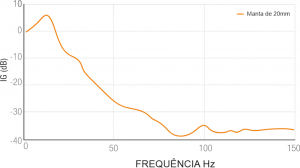
Resilient mats installed under the ballast mitigate dynamic loads, vibration, and noise, and also protect the ballast from disintegration. However, their main purpose is to reduce track stiffness, especially when installed in the stiffest sections, such as bridges, tunnels, overpasses, etc. In addition, they can be used in various operational environments, such as conventional main lines, urban or high-speed lines, or light rail and subway tracks.

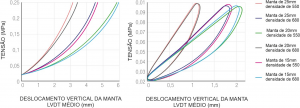
The resilient mat applied beneath the ballast is manufactured in thicknesses ranging from 15 to 30 mm. Its types can be classified as HARD, MEDIUM, or SOFT depending on the dynamic compression modulus, according to the values in the following table.

Installation Requirements

To avoid any risk of ballast flow, it is highly recommended that the ballast side supports“” should be installed when UBMs are used where the ballast box profile is open on the sides (i.e., where the ballast is not retained); this is common in the case of open tracks adjacent to embankments.

To prevent any slippage of the UBM during installation or during ballast cleaning, it is recommended that the UBM be bonded to the substructure. To ensure compatibility of the adhesive with the UBM material and type of substructure, the use of PU resins is recommended.

The substructure on which the UBM is installed must be flat and clean (e.g., asphalt layer, concrete layer) to prevent additional elasticity and ensure suitability for bonding.

In cases of high-performance structural noise or vibration reduction in tunnels, bridges, and ballast boxes, the UBM should be installed on the side walls, kept below the top surface of the ballast for practical reasons

The substrate on which the UBM is installed must be flat and clean (e.g., asphalt layer, concrete layer) to prevent additional elasticity and ensure suitability for bonding.

In cases requiring high-performance structural noise control or vibration reduction in tunnels, bridges, and ballast boxes, the UBM must be installed on the side walls, maintained below the top surface of the ballast for practical reasons (e.g., for fire protection and equipment clearance).

The mats should be installed in such a way that drainage of the substructure is not affected.

To prevent direct contact between the ballast and the substructure, there should be an overlap between adjacent sections of the UBM. In tunnels, it is recommended that the UBM be installed on the sidewall to maximize the UBM’s effect against vibrations. However, for fire safety, the top level of the UBM must be kept below the top surface of the ballast.

Limitations

A) UBM Lower resilient mats and destabilization of the ballast.

The influence of the modulus of resilient mats placed beneath the ballast on track stability must be considered in relation to the track’s natural frequency, subgrade quality, and excessive vertical deflections of the track.

The natural frequency of the track decreases as the layer modulus decreases.

In the case of relatively high layer modulus values, the additional vertical deflections of the track due to the use of UBM should not be the cause of such phenomena.

In the case of UBM with a relatively low stratification modulus, there is a risk of ballast destabilization, especially at high train speeds. Therefore, limiting the dynamic flexibility of the UBM is a good way to prevent this phenomenon. Very soft and soft UBM should be avoided for high-speed tracks.

B)Possibility of combining the use of UBM with USP.

It is important to note that combining these two systems affects the overall flexibility of the track and its dynamic behavior, and may affect ballast stability in unpredictable ways. This combined use of two systems does not directly translate to the sum of the individual advantages offered by each system. Therefore, it is recommended not to combine them unless additional investigations have been conducted for specific projects

C)UBM and braking forces .

The influence of longitudinal forces acting on the rails on the UBM’s shear modulus is negligible: no significant additional deformation is produced in the track during braking due to the presence of the UBM. In contrast to the case of the nose, braking forces would not in themselves imply a significant limitation on the UBM’s shear modulus

RESILIENT MATS FOR TRACK SLABS

(STM – Slab Track Mats)

In ballastless track systems, resilient mats serve a similar purpose to mats under ballast. However, a ballastless track system is always a custom engineering solution for a specific application. Therefore, in accordance with DIN-45673-7 and EN 17686, mats must be tested for each project according to the specifications of that project:

  • F0 Minimum load
  • F1 Service load Evaluation load
  • F2 Load assessment in slab calculation
  • F3 Maximum load on the slab

Before testing, a simulation of the insertion loss can be performed to select the most suitable material for each project

RESILIENT SUPPORTS FOR RAIL SLEEPERS

(USP Under Sleeper Pads)

Resilient supports for railway sleeper bases (USP) are installed beneath the bases to distribute axle loads across a large number of sleepers. USPs generally serve two purposes: to dampen vibration and to protect the sleepers from the impact load transmitted through the ballast. USPs can increase the contact surface between sleepers and ballast, which helps stabilize the top layer of ballast. Furthermore, one of the greatest benefits of USPs is reducing the dynamic load on the ballast, which leads to a reduction in ballast displacement and track settlement.

The benefits of using USP supports presented are shown below:

  • Improves track quality by reducing dynamic load
  • Reduces ballast thickness without compromising performance
  • Reduces ground vibration frequency above 50 Hz
  • Reduces long-wave undulation in sharp curves of the track, as USP can modify the natural frequencies of track components.
Reviews (0)

Reviews

There are no reviews yet.

Be the first to review “Railway Components”

Your email address will not be published. Required fields are marked *